
We're always glad to share when our translation support has helped a practitioner move an appeal forward. This case study walks through a recent engagement with Advocate Chirag Mathur of Lasa Legal Associates, whose client's GST appeal before the GST Appellate Tribunal (GSTAT), Ghaziabad Bench, was flagged with multiple defects, one of them squarely a translation issue under Rule 23 of the GSTAT (Procedure) Rules, 2025.
Background: A Defect Notice at the Scrutiny Stage
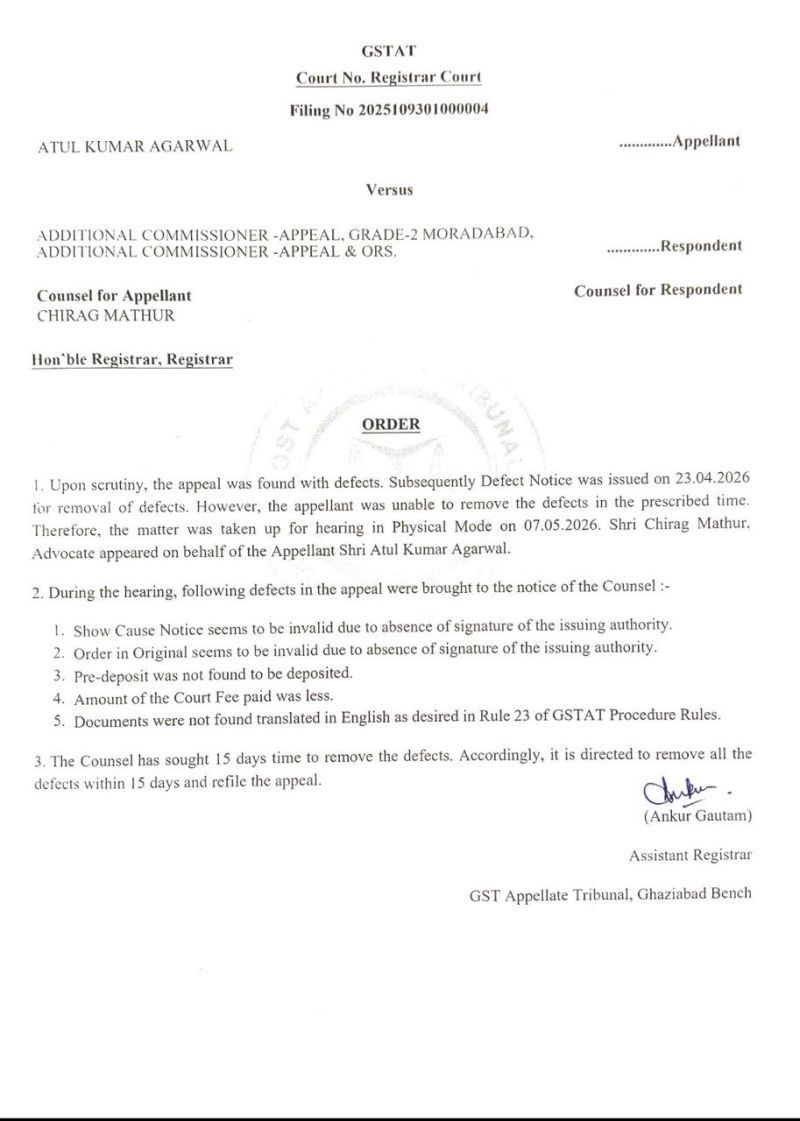
When the appeal was taken up for scrutiny, the Registrar's office found it carried several defects and issued a Defect Notice. Since the defects were not removed within the prescribed time, the matter came up for a physical hearing before the Hon'ble Registrar at the GSTAT Ghaziabad Bench, where Advocate Chirag Mathur appeared on behalf of the appellant.
During the hearing, the Bench identified five distinct defects in the filing:
Defects noted in the Registrar's Order
- Show Cause Notice appeared invalid due to absence of signature of the issuing authority
- Order in Original appeared invalid due to absence of signature of the issuing authority
- Pre-deposit was not found to be deposited
- Amount of Court Fee paid was less than required
- Documents were not found translated in English as desired in Rule 23 of the GSTAT Procedure Rules
The Bench granted 15 days to remove all defects and refile the appeal: a tight window when one of the defects requires arranging a certified translation of the underlying Hindi documents.
Where Jurify Came In
Defect #5, the absence of certified English translations as required under Rule 23 of the GSTAT (Procedure) Rules, 2025, is exactly the kind of procedural gap our translation services are built to close quickly. Advocate Mathur reached out to Jurify to get the relevant Hindi documents translated into English in a form suitable for resubmission to the Tribunal.
Our team translated the underlying documents from Hindi into structured, accurate English, preserving section references, dates, amounts, and party names exactly as they appeared in the originals: the level of fidelity that a tribunal filing demands.
The Outcome
The translated documents were submitted to the State GST authorities and were accepted, clearing the translation-related defect that had been flagged in the Registrar's order. That removed one of the key obstacles standing between the appellant and a properly admitted appeal: exactly the kind of procedural unblock that keeps a matter moving instead of stalling at the registry stage.
The Broader Pattern
This engagement is a clear illustration of a trend we've written about before: as GSTAT formalises its procedure under the 2025 Rules, translation is no longer a courtesy step. It's a filing requirement that can determine whether an appeal is admitted or returned at scrutiny. Practitioners handling matters that originate from Hindi-speaking states (Uttar Pradesh, Madhya Pradesh, Rajasthan, Delhi, and others) should expect Rule 23 objections to become more common, not less, as Benches enforce the rule consistently.
Building translation into the appeal-preparation workflow, rather than treating it as a last-minute fix after a defect notice, is the difference between a smooth refiling and a scramble against a 15-day clock.
For more on what Rule 23 requires and how the interim relaxation works, see our explainer on the GSTAT Hindi order translation rule.
How Jurify Can Help Your Matter
At Jurify, we assist taxpayers, consultants, and legal professionals with technology-enabled translation solutions for GST and litigation-related documents, from Show Cause Notices and Orders in Original to appellate orders and supporting annexures. Whether you're preparing a fresh filing or responding to a defect notice under a tight deadline, our LexLingo platform and certified translation service are built to help you move quickly without compromising on accuracy.